For Testing & Calibration Laboratories
Build ISO 17025-Ready Uncertainty Budgets
A browser‑based uncertainty evaluation tool implementing the GUM (JCGM 100:2008), designed for both testing and calibration laboratories. Supports ISO/IEC 17025 Clause 7.6 with transparent, assessor‑reviewable calculation steps — and 200+ real-world worked examples to get you started fast.
Transparent
Every calculation step is explicit and reviewable — no black boxes, no hidden formulas.
GUM-Correct
Strict implementation of JCGM 100:2008 for both testing and calibration measurement models.
Assessment-Ready
Structured for ISO/IEC 17025 technical review across testing and calibration scopes.
Built for Both Lab Types
Whether you're evaluating measurement uncertainty in a testing lab or a calibration lab, the calculator handles the specific requirements of each.
Testing Laboratories
- ✓ Chemical and physical test method uncertainty
- ✓ Environmental testing (temperature, humidity)
- ✓ Mechanical testing (tensile, hardness, impact)
- ✓ Electrical and EMC testing
- ✓ Food, water, and material analysis
- ✓ Support for Eurachem/CITAC CG 4
Calibration Laboratories
- ✓ Mass, length, pressure, and voltage calibration
- ✓ Temperature and humidity calibration
- ✓ Time, frequency, and volume
- ✓ Welch–Satterthwaite effective degrees of freedom
- ✓ Coverage factor k from t-distribution
- ✓ GUM Annex H-style uncertainty budget output
200+ Real-World Worked Examples
Load any example directly into the calculator. Each one is a complete, GUM-compliant uncertainty budget you can learn from, adapt, and submit for assessment.
Why not spreadsheets?
Application Interface
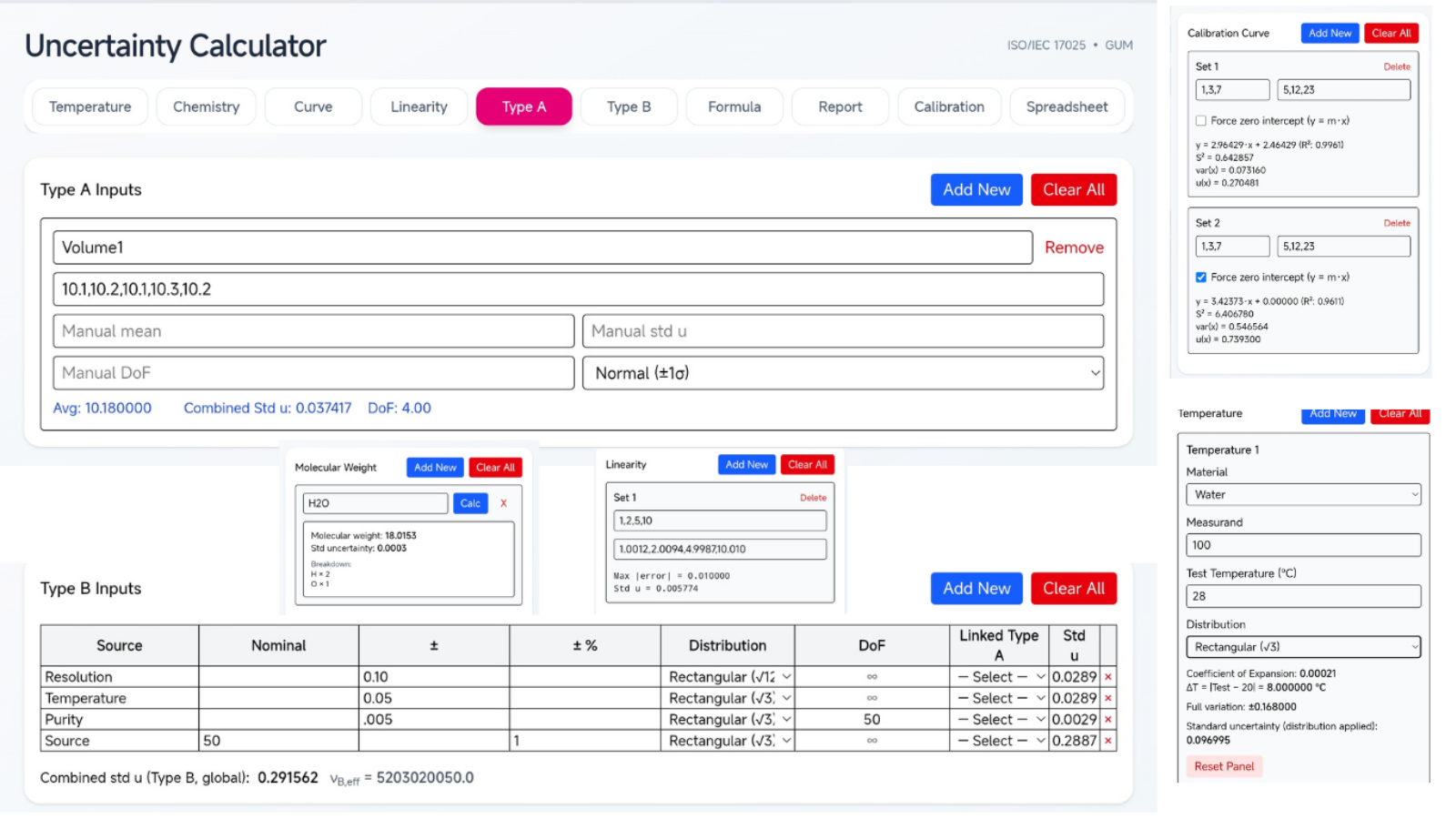
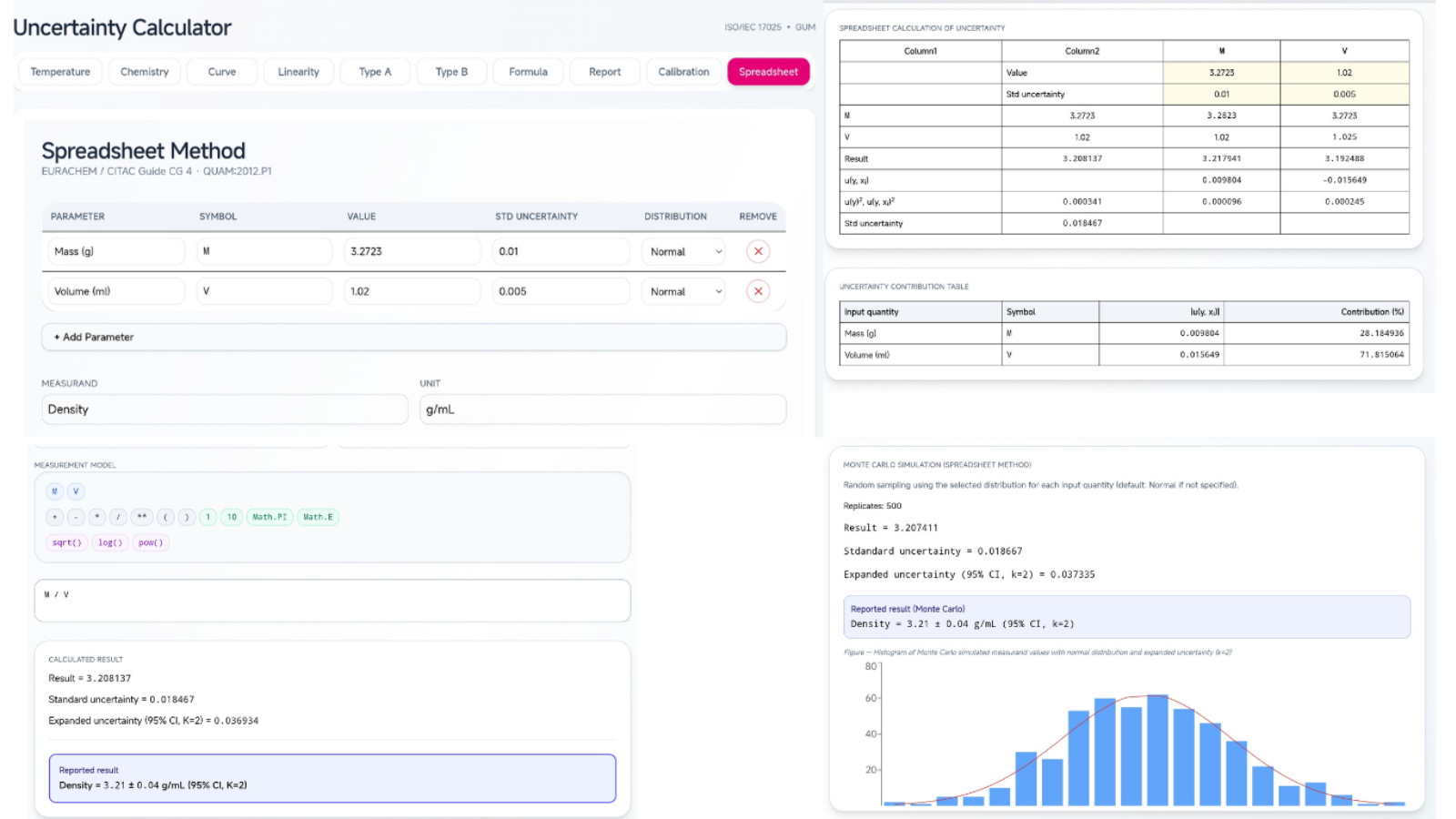
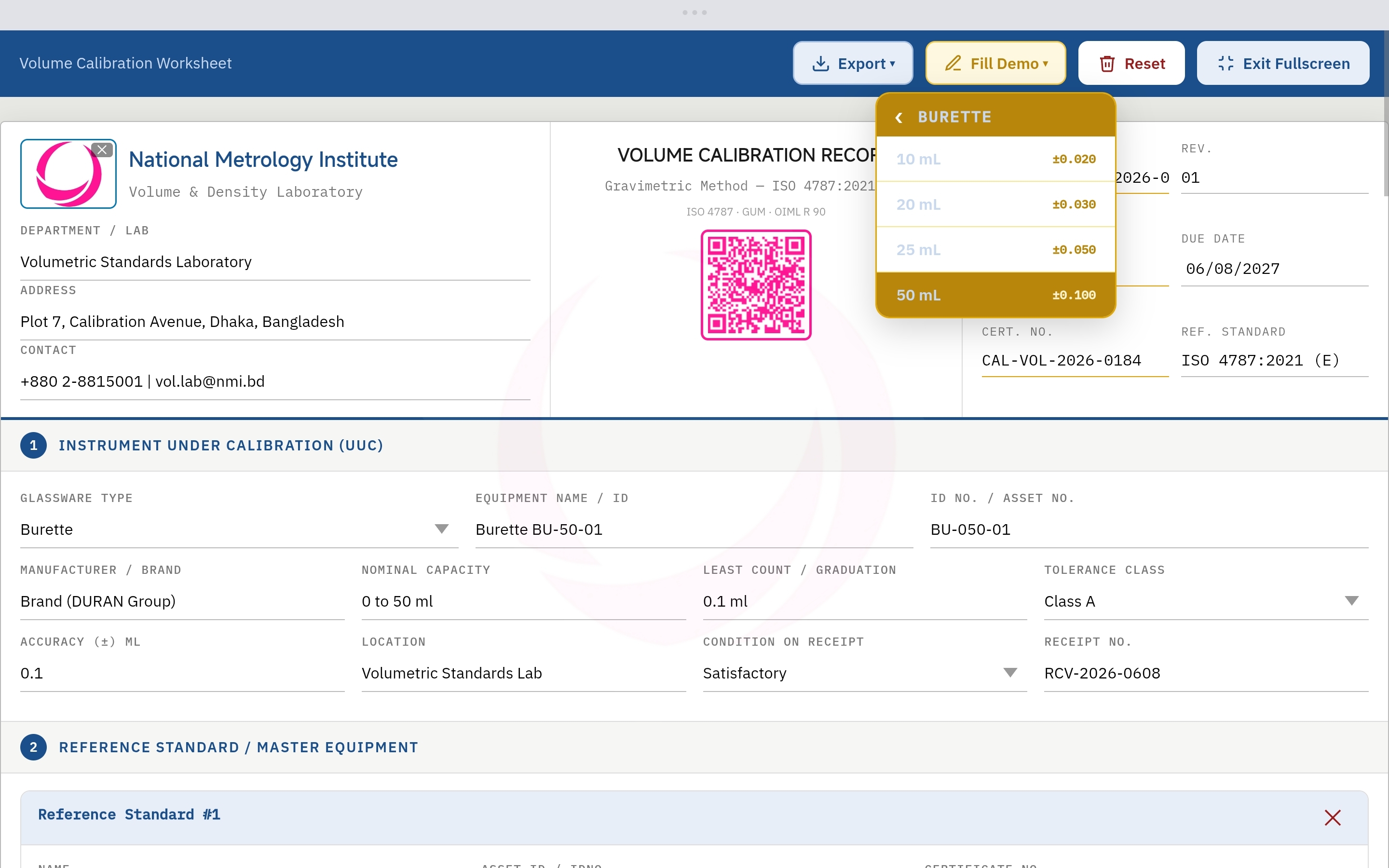
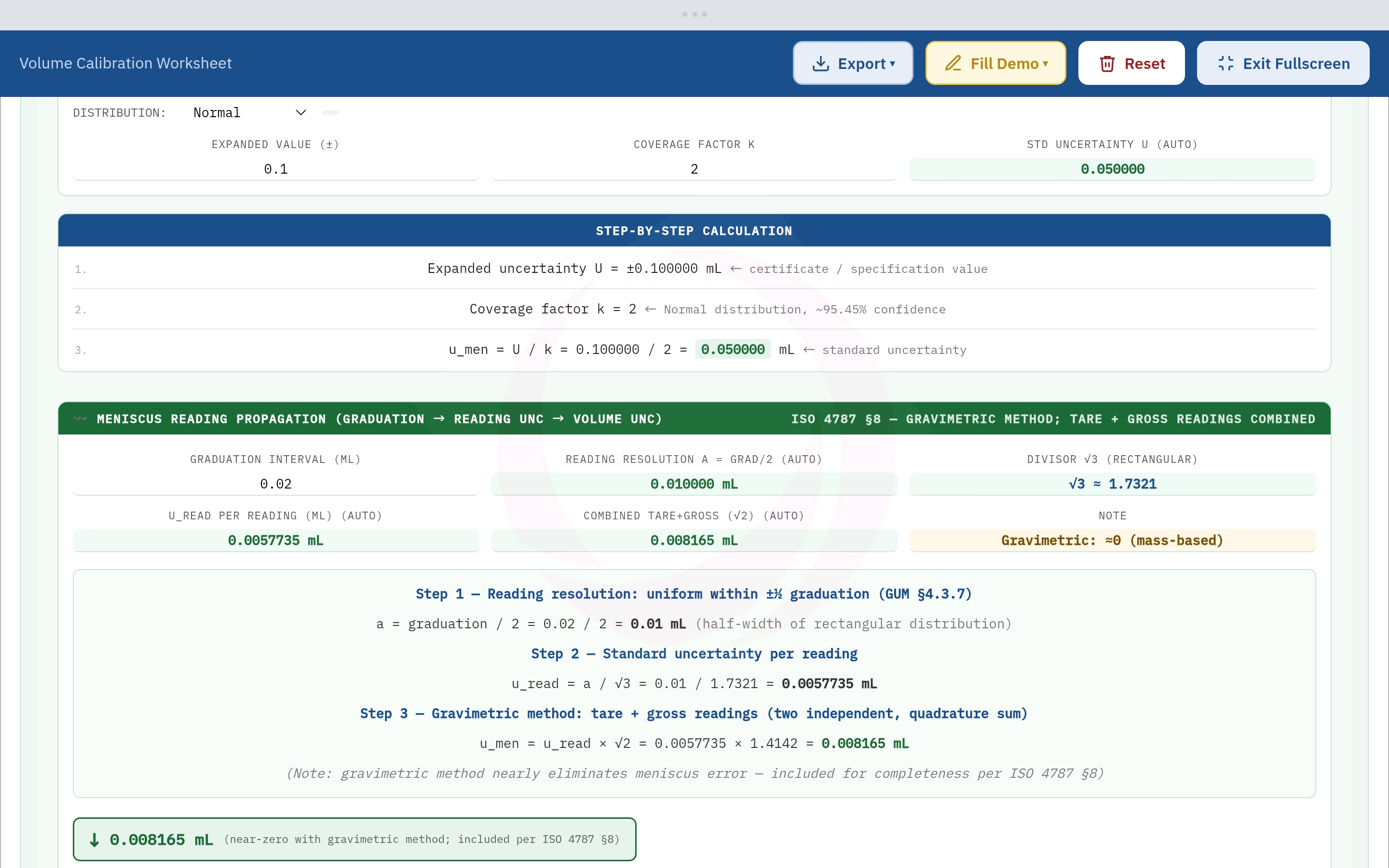
Measurement Uncertainty Methodology
1. Purpose, Scope, and Standards
This methodology describes the principles, assumptions, and calculation procedures implemented in the Uncertainty Calculator for the evaluation of measurement uncertainty in both testing and calibration laboratories. The methodology is written to support laboratories operating under ISO/IEC 17025:2017, with particular reference to Clause 7.6 (evaluation of measurement uncertainty) and Clause 7.8.3 (reporting of results).
2. Measurement Model
Each uncertainty evaluation begins with the explicit definition of a measurement model. The measurand y is defined as a function of one or more input quantities x₁, x₂, …, xₙ according to: y = f(x₁, x₂, …, xₙ). All input quantities are expressed as estimates with associated standard uncertainties.
3. Type A Uncertainty Evaluation
A Type A evaluation of standard uncertainty is obtained from statistical analysis of repeated observations, in accordance with GUM §§4.2–4.3. This approach is used when repeated measurements of the same measurand are available under appropriate conditions of repeatability or reproducibility.
4. Type B Uncertainty Evaluation
A Type B evaluation of standard uncertainty is used when a component of uncertainty is evaluated by means other than statistical analysis of repeated observations, as defined in GUM §4.3. This evaluation is based on scientific judgment using all available information relevant to the possible variability of the input quantity.
5. Combination of Uncertainty Components
The combined standard uncertainty is evaluated using the law of propagation of uncertainty in accordance with GUM Clause 5. A first‑order Taylor series expansion of the measurement model is applied: u_c(y) = √( Σ ( cᵢ · u(xᵢ) )² )
6. Degrees of Freedom and Expanded Uncertainty
When uncertainty components are associated with finite degrees of freedom, the effective degrees of freedom of the combined standard uncertainty are estimated using the Welch–Satterthwaite equation, as recommended in GUM Clause 6. The expanded uncertainty U is obtained by multiplying the combined standard uncertainty by a coverage factor k determined from the Student t‑distribution.
7. Reporting, Limitations, and Responsibility
Reported measurement results shall include the measured value, the expanded uncertainty, and the applied coverage factor, in accordance with ISO/IEC 17025 Clause 7.8.3. All assumptions and distribution models used in the evaluation shall be documented. Final responsibility for the validity, suitability, and reporting of uncertainty results remains with the laboratory.
Ready for testing & calibration labs
Evaluate measurement uncertainty the GUM-correct way. Start from one of 200+ worked examples or build your own budget from scratch — free, no account required.